

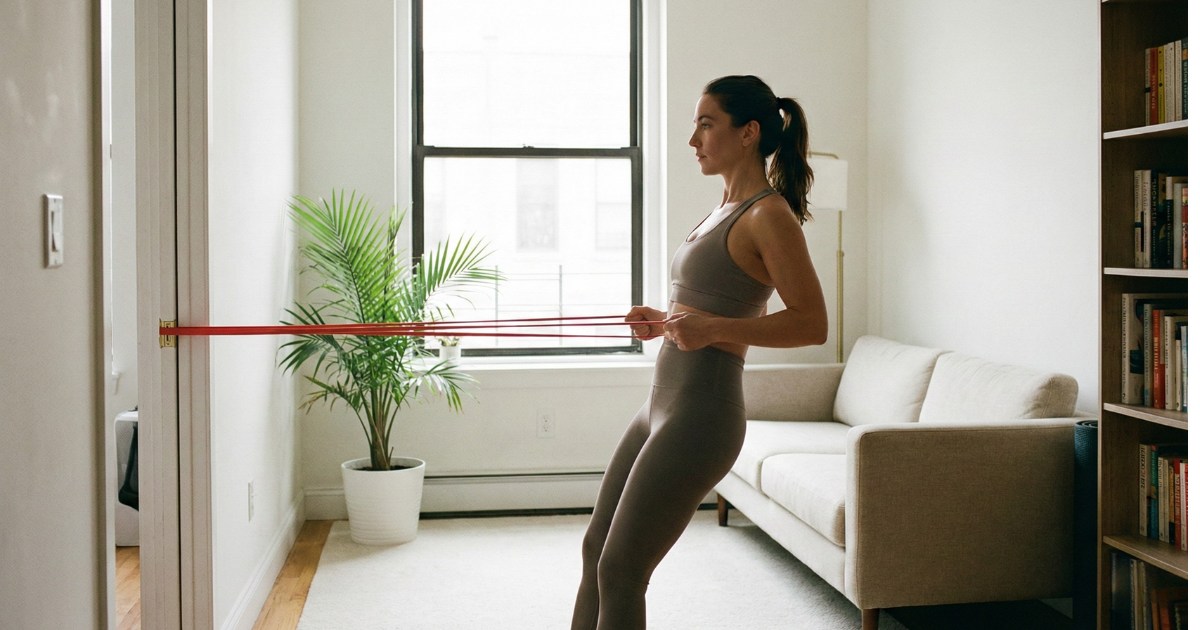
You don’t need a gym, heavy weights, or a spare room to get strong. In fact, resistance bands are one of the best tools for strength training in small spaces. They’re quiet, inexpensive, easy to store, and incredibly effective when used correctly.
This complete guide shows you how to build real strength in a tiny room using resistance bands, explains why they work so well, and gives you a clear structure you can follow without overthinking.
Whether you live in a studio apartment, dorm, or shared home, this approach is designed to fit your space and your life.
Why Resistance Bands Are Perfect for Small Spaces

Resistance bands create tension without relying on gravity. That makes them ideal for environments where:
-
You can’t drop weights
-
You don’t want noise
-
Space is limited
-
Storage matters
Key benefits:
-
Take up almost no space
-
Extremely joint-friendly
-
Easy to scale for beginners or advanced users
-
Allow full-body training in one spot
Strength isn’t about equipment—it’s about tension and control. Bands deliver both.
Read Also – Low-Impact Cardio for Overweight Beginners
What You Need (Very Little)
To get started:
-
One long loop resistance band (light or medium)
-
Optional mini loop band for glutes and legs
-
Floor space about the size of a yoga mat
That’s it.
How to Train with Bands Effectively
Before jumping into exercises, keep these rules in mind:
-
Move slowly (2–4 seconds per rep)
-
Maintain constant tension—don’t let the band slack
-
Stop 1–2 reps before failure
-
Focus on form over resistance level
Bands work best when you control them—not when you rush.
Full-Body Small-Space Strength Exercises (Band-Based)
Below are foundational band exercises that work in tight spaces and build real strength.
1. Banded Squat
Works: Legs, glutes, core
How:
Stand on the band, loop it over shoulders or hold at chest. Squat slowly.
Why it’s great:
No jumping, no noise, maximum lower-body activation.
2. Banded Reverse Lunge (In Place)
Works: Legs, glutes, balance
How:
Front foot on band, ends in hands. Step one foot back and lower.
Small-space bonus:
Reverse lunges need less room and are easier on the knees.
3. Banded Chest Press
Works: Chest, shoulders, triceps
How:
Anchor band behind you (door or around back). Press forward.
Tip:
Pause briefly at full extension to increase difficulty.
4. Banded Row
Works: Upper back, arms
How:
Anchor band in front, pull elbows back and squeeze shoulder blades.
Why it matters:
Balances pushing movements and supports posture—especially for desk workers.
5. Banded Shoulder Press
Works: Shoulders, arms
How:
Stand on band and press overhead slowly.
Small-room friendly:
Vertical movement, zero floor travel.
6. Banded Glute Bridge
Works: Glutes, hamstrings
How:
Lie on back, band above knees. Push hips up and hold briefly.
Joint-friendly and quiet.
7. Pallof Press (Anti-Rotation Core)
Works: Deep core muscles
How:
Anchor band to the side. Press band straight out and resist rotation.
Why it’s powerful:
Builds real-world core strength without crunches.
8. Banded Dead Bug
Works: Core stability
How:
Anchor band overhead. Lower opposite arm and leg slowly.
Focus:
Control, not speed.
9. Squat Hold with Band
Works: Legs, glutes, endurance
How:
Band above knees, hold squat position and press knees outward.
Tiny-space secret:
Isometrics build strength without movement.
10. Plank with Band Pull-Apart (Optional)
Works: Core, shoulders
How:
Hold plank while pulling a light band apart.
Sample Small-Space Band Workout (20–30 Minutes)
Do 2–3 rounds:
-
Banded Squats – 12 reps
-
Banded Chest Press – 10 reps
-
Banded Rows – 12 reps
-
Reverse Lunges – 8 reps/side
-
Pallof Press – 10 reps/side
-
Plank – 30 seconds
Rest 60 seconds between rounds.
How Often Should You Train?
-
3–4 days per week is ideal
-
Leave at least one rest or light day between hard sessions
-
Consistency matters more than intensity
How to Progress (Without More Space)
Progress by:
-
Using a slightly heavier band
-
Slowing each rep
-
Adding 2–3 reps per set
-
Increasing hold times by 10–15 seconds
You don’t need new exercises—just better tension.
Common Small-Space Mistakes
-
Rushing reps
-
Using bands that are too heavy too soon
-
Ignoring posture and control
-
Training every day without rest
Quiet training doesn’t mean easy training.
Who This Style of Training Is Best For
-
Apartment and dorm residents
-
Beginners starting strength training
-
People who want low-impact workouts
-
Anyone short on time or space
If you can fit a yoga mat, you can get stronger.
Final Takeaway
Resistance bands turn even the smallest room into a functional strength-training space. They’re proof that you don’t need more space—you need better tools and smarter training.
Quiet. Controlled. Effective.
Strength isn’t about where you train.
It’s about how consistently you show up.
